From Content Inventory to Content Intelligence: AI-Assisted Governance for Drupal
Before a website migration, redesign, or modernization effort can begin, content teams often face a surprisingly difficult question: What do we actually have?
For a large Drupal environment, answering that question can mean reviewing thousands or tens of thousands of pages, taxonomy terms, media assets, authors, metadata fields, and years of accumulated content.
Then more questions: Which content is duplicated? What is outdated? Where has taxonomy drifted over time? Which pages no longer support the organization’s mission? What should be migrated, consolidated, rewritten, or retired?
Traditional content inventories can take weeks or months of manual analysis before teams have enough information to confidently begin making those decisions. CTAC developed Content Optimizer, an AI-assisted content governance solution, to dramatically accelerate that process and turn content inventory data into actionable intelligence.
A Faster Way to Understand a Large Content Estate
Content Optimizer helps organizations analyze, prioritize, and improve large Drupal content estates, supporting everything from content health reviews and duplicate identification to taxonomy improvement, pre-migration rationalization, and ongoing editorial governance. Rather than beginning a modernization effort with weeks of spreadsheet creation and manual page-by-page review, teams can establish a content baseline, identify patterns across the estate, and quickly focus attention on the areas most in need of human review. The result is a more informed starting point for decisions about what to keep, consolidate, improve, migrate, or retire.
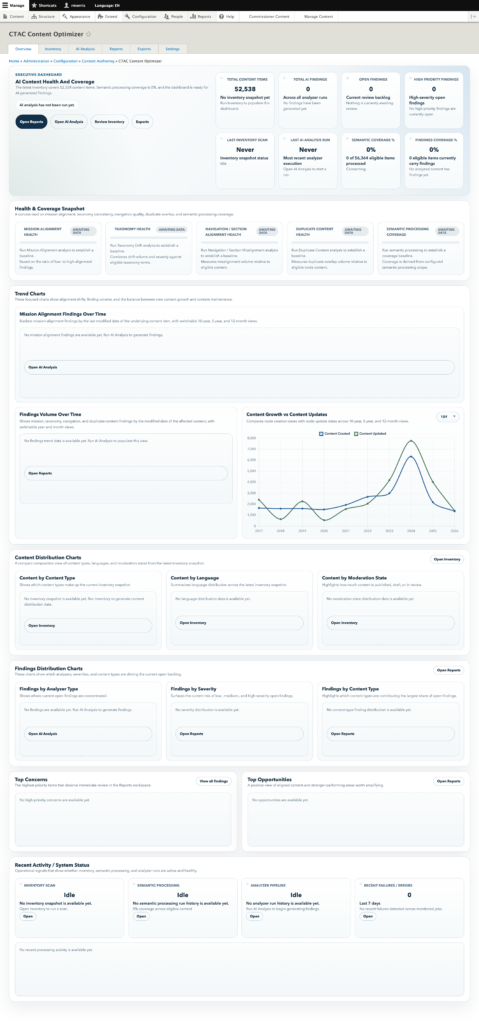
Content Optimizer provides an executive-level view of content health, coverage, findings, trends, and activity across the Drupal content estate. The dashboard includes content counts, findings, semantic coverage, mission alignment, taxonomy health, duplicate-content health, content-growth trends, distribution metrics, top concerns, opportunities, and system status.
Combine Deterministic Inventory With AI-Assisted Analysis
One of Content Optimizer’s strengths is that organizations do not have to send their entire content estate to an AI model simply to understand what exists. The Inventory establishes a deterministic snapshot of the Drupal environment, providing the foundation for analysis without requiring AI. From there, organizations can selectively apply AI-assisted analysis where it adds value.
Content Optimizer currently supports analysis across areas including:
- Mission Alignment — identifying content that may be weakly aligned with organizational or program missions.
- Taxonomy Drift — surfacing inconsistent, overlapping, or evolving terminology.
- Navigation and Section Alignment — identifying content that may not logically fit within its current location.
- Duplicate Content — identifying exact duplicates as well as semantically similar content.
The platform can also distinguish between exact duplicate detection and semantic duplicate analysis, allowing organizations to configure the type and sensitivity of analysis appropriate for their environment.
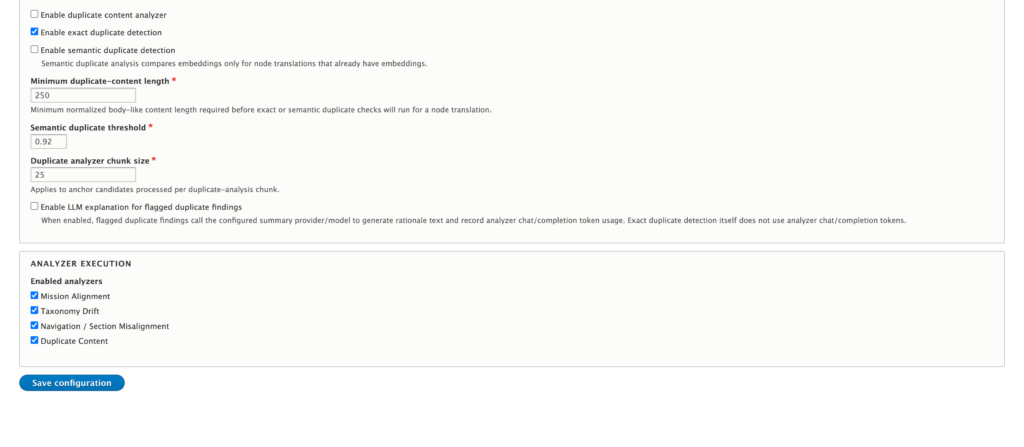
Organizations can choose which analyzers to run and configure duplicate-content thresholds, semantic matching, processing limits, and AI-generated explanations.
Find Taxonomy Problems That Are Easy for Humans to Miss
Taxonomies evolve. One content author might use “chairman,” another “chairperson,” and another simply “chair.” A new organizational structure might introduce terminology that overlaps with vocabulary established years earlier. Individually, these inconsistencies may seem minor. Across thousands of pages, however, they can affect search, navigation, filtering, reporting, and the overall coherence of the user experience.
Content Optimizer can analyze these patterns and surface taxonomy drift for review rather than requiring a content strategist to manually compare every term in the system. Our AI does not make the governance decision, but it helps humans identify where a decision is needed.
Evaluate Whether Content Still Supports the Mission
Content quality is not only about whether a page is grammatically correct or recently updated. For public-sector organizations in particular, another question matters: Does this content still support what the organization is trying to accomplish?
Content Optimizer can use agency and program mission information as context for evaluating content alignment. That may include an agency-wide mission statement as well as more focused missions associated with sections, programs, or service areas. For example, an organization responsible for public safety and recalls can evaluate whether content within a recall-focused area meaningfully supports those responsibilities, or whether portions of the content estate may need to be revisited. The objective is not to allow AI to determine what an agency should publish. It is to give content owners another data point for identifying content that deserves review.
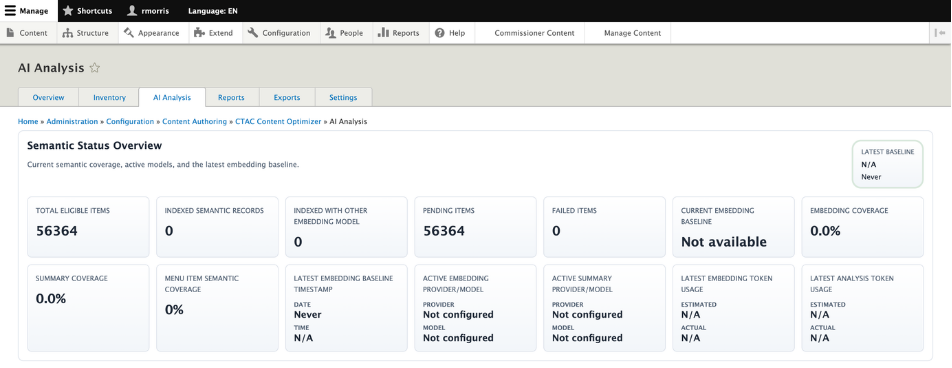
The AI Analysis workspace provides visibility into analyzer coverage, mission configuration, processing status, findings, and source coverage.
Configure AI Around the Organization’s Requirements
Content Optimizer allows teams to configure analysis based on their technical, operational, and data-management requirements. Your notes specifically call out the ability to exclude sensitive fields and choose preferred AI providers and models.
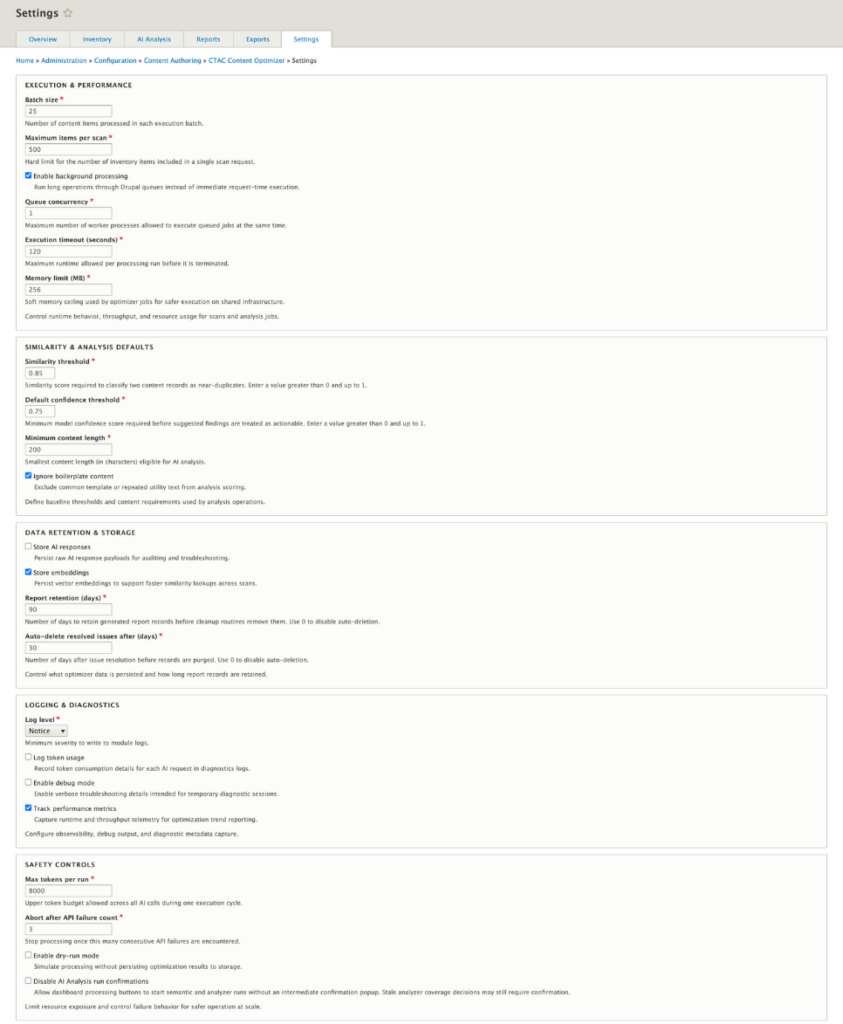
The broader platform settings shown in the tool also provide control over areas such as:
- Similarity and confidence thresholds
- Batch size and processing limits
- Data retention
- Logging and diagnostics
- Token usage and estimates
- Storage of embeddings or AI responses
- API-failure safeguards
- Export formats
For large organizations, and particularly government environments, that kind of configurability is important. It allows the technology to adapt to the organization’s governance requirements rather than forcing the organization to adapt to the AI.
Turn Thousands of Findings Into a Prioritized Review Queue
Finding problems is only useful if teams can act on them. Content Optimizer’s Reports workspace gives teams a central place to review and triage findings across mission alignment, taxonomy drift, navigation or section misalignment, and duplicate content. Findings can be filtered using criteria such as content type, vocabulary, language, severity, status, score, date, and free-text search. That makes an important difference. Instead of handing a content team a spreadsheet containing thousands of rows and telling them to “clean up the site,” teams can focus on a manageable subset:
Show me our highest-severity duplicate-content findings. Or: Show me low-scoring mission-alignment findings in this content type. Or: Show me taxonomy issues associated with this vocabulary.
The technology helps turn a broad content-cleanup exercise into a prioritized governance workflow.
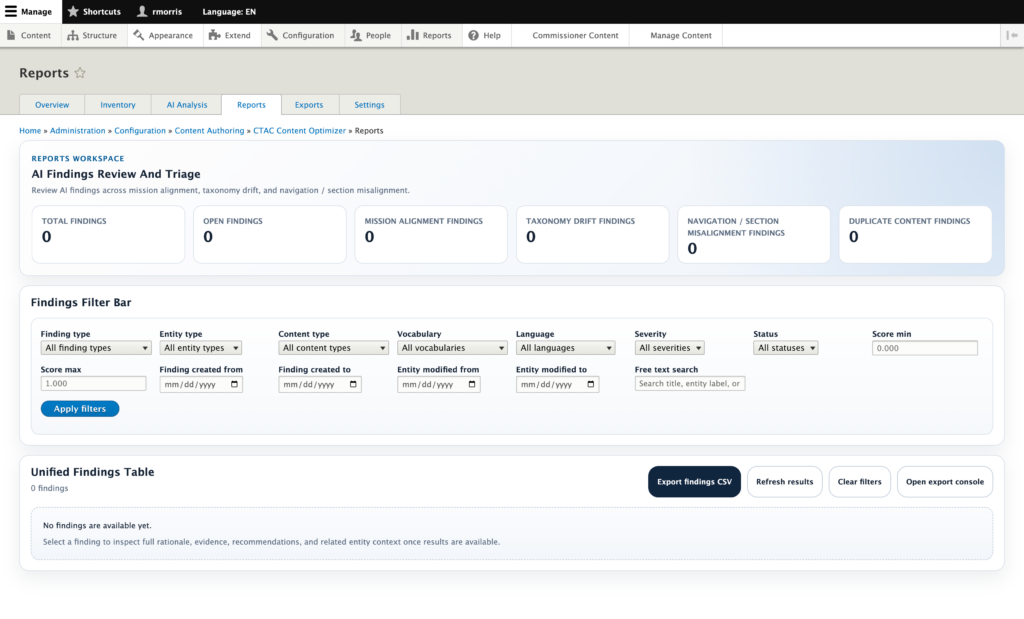
Findings can be filtered, reviewed, prioritized, and exported using content, severity, status, score, date, and other governance criteria.
Create Evidence, Not Just Insights
Content Optimizer also gives teams extensive export capabilities, making the analysis useful beyond the application itself. Teams can export inventory snapshots and detailed listings of nodes, taxonomy, and media, as well as metrics for content creation, content updates, age distribution, churn, languages, moderation states, and user activity. AI findings can also be exported separately or together, including mission-alignment findings, taxonomy drift, section-misalignment findings, and duplicate-content findings.
This creates a reusable evidence base for:
- Migration planning
- Content-owner remediation
- Governance working sessions
- Leadership reporting
- Roadmapping
- Content-strategy deliverables
- Post-modernization measurement
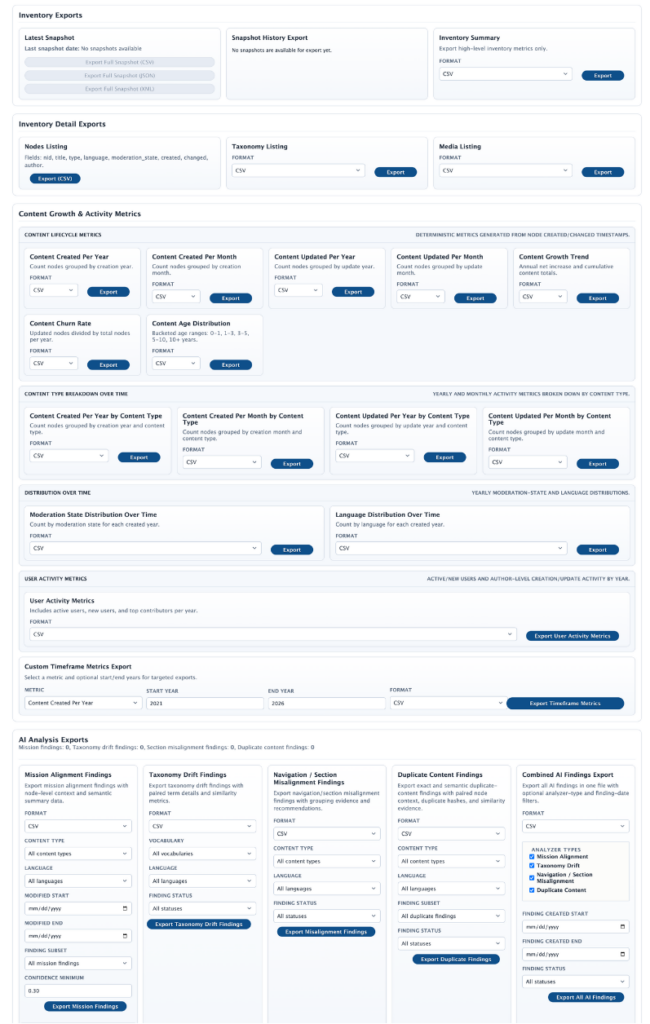
Content Optimizer produces exportable inventory, lifecycle, taxonomy, activity, and AI-analysis data for downstream planning and reporting.
Measure Improvement Instead of Repeating the Audit
Content governance should not end when a migration launches. Content changes continuously. New pages are added. Existing pages age. Terminology evolves. Content ownership shifts. For that reason, Content Optimizer can become part of an ongoing governance model rather than a one-time migration utility. Organizations can establish a baseline, run the tool again at the completion of a major epic or modernization phase, and compare the difference. Assessments can also be conducted periodically for example, quarterly, to understand whether internal content-management efforts are maintaining or improving content health.
That allows teams to answer more meaningful questions:
- Has duplicate content decreased?
- Has taxonomy consistency improved?
- Are fewer pages falling outside established mission areas?
- Are content owners maintaining the improvements made during modernization?
- Which parts of the site are accumulating content faster than they are being maintained?
From AI Analysis to Better Human Decisions
Content Optimizer is not intended to replace content strategists, editors, subject-matter experts, or content owners. It is designed to eliminate some of the most time-consuming work required before those experts can make good decisions. Instead of asking people to manually examine thousands of pages to discover patterns, AI and automated analysis can identify where those patterns exist. CTAC then brings the technology together with human expertise to help customers interpret the findings, prioritize action, and move into modernization work faster.
What’s Next: Connecting Content Health to Digital Performance
The next step is making content prioritization even richer.
Future enhancements could incorporate site analytics as another factor in determining priority. For example, a duplicate or poorly aligned page is important but the urgency may be different if that page receives 20 visits a year versus 200,000. Connecting content findings to Google Analytics or other site-performance metrics could help teams evaluate both content health and user impact.
Accessibility data presents another opportunity. Integrating Section 508 findings could provide organizations with a broader view of digital quality that combines: Content health + accessibility + performance + mission alignment. The result is a more complete foundation for deciding where modernization resources will deliver the greatest value.
Start Modernization With Better Information
Content-heavy modernization efforts are difficult enough without spending the first several weeks trying to determine what already exists. Content Optimizer gives Drupal teams a faster way to understand their content estate, surface areas for improvement, prioritize remediation, and measure progress over time. Whether an organization is preparing for a migration, redesigning an intranet, cleaning up years of accumulated content, or strengthening an ongoing governance program, the goal is the same:
Move faster from “What do we have?” to “What should we improve next?”
Email contact@ctacorp.com to set up an AI demo.